
A Prayer Returning to the Temple of Atopos


시간을 눌러 새기듯 오랜 시간 핀화의 중첩된 층위를 탐구해온 박상아 작가.
그의 개인전 《 아토포스 Atopos의 사원으로 돌아오는 기도 》 가 4월 3일부터 4월 24일까지 컴바인웍스 갤러리에서 개최된다
Humanity has long leaned toward "something." Whether that something was a god, a desperate yearning, or simply a wish for things not to disappear remains unknown. Yet, in the moment of joining hands before a fear that cannot be named, humans become simultaneously their most fragile and their most resilient. We knelt, we molded clay, and we lit fires. The temples thus created were less architectural structures and more the primordial direction of the human heart.
'Atopos' (ἄτοπος) in Ancient Greek signifies a place that belongs nowhere completely—a position that defies definition. Plato used this concept to describe Socrates, who refused to settle within established systems of knowledge. It does not merely mean "placelessness," but rather a state of non-regulation that exists prior to language, categories, or institutions. It is an ambiguity that vanishes the moment one tries to name it and slips away when one tries to define it.
The artist carefully places this mystery before the name of her temple. The "Temple" reimagined in this exhibition is not a space of religious dogma or hierarchy, but a sanctuary (聖所) where the fragile emotions of humans, non-humans, and myriad living beings brush against one another. It is a space that does not close itself off with specific creeds; rather, it is an ever-living, shifting space in which the collective earnestness of different existences lingers briefly before vanishing. A Prayer Returning to the Temple of Atopos is a record of the moment we return to our lost, original senses—a story about a certain state of being.
For over twenty years, from her undergraduate and graduate studies to the present, Artist Sang-a Park has silently engraved herself into the world of printmaking. Her trajectory—measuring the depth of ink soaking into paper and exploring the unique materiality of the "plate"—evolved through Your Natural Wish and My Temple (2024) and Floating Guessed Messages (2025). If one question has pierced her entire journey, it is this: How can an invisible prayer take on a material form and remain by our side?
In 2026, her long contemplation finally culminates in the "Temple of Atopos," a sanctuary belonging to no logical category. This is not a simple expansion of a series. It marks a decisive moment of transformation where the artist, who has long guarded the flat surface, pulls the primordial life force of earth and fire up to the terrestrial realm.
In this body of work, the artist momentarily sets down her familiar metal burin and picks up a "squeeze bottle"—a tool both unfamiliar and soft. The round starting point of ink forming at the tip of the needle resembles the lump of emotion that first condenses deep in the chest when we begin a prayer. Feelings not yet turned into sentences and yearnings without form are condensed like a single dot before finally being pushed outward. Lines that thicken or thin according to the pressure of the hand move across smooth paper and finally onto the coarse surface of clay.
The process where a line becomes the body of a ceramic vessel, and that clay endures the baptism of fire in the kiln to become a solid image (象), reveals a point of contact between the controllable pressure of the human hand and the uncontrollable action of fire—the forces of the universe. What she confesses through clay, after being immersed in the flatness of paper for so long, is not a mere expansion of media, but a sense of liberation as a "being that has come ashore."
The humans and animals appearing in her work are not placed within a religious hierarchy. They are all fragile creatures sharing the fundamental emotion of fear. Their gestures of wanting to lean on something beyond the terror of survival quietly tell us that the essence of the religious rituals we believed to be "divine" was, in fact, a confession of vulnerability.
The artist’s fingerprints are engraved upon the clay, and the beings within the work take on gestures as if performing a ritual. It feels less like an act of worship toward a god and more like a posture for enduring fear—a rhythm for crossing through anxiety. Gods were likely created this way, and rituals likely began in this manner.
If printmaking is humanity’s oldest device for engraving and disseminating information, clay remembers the moments of trembling and hesitation that occurred during that process of engraving. The two worlds—three-dimensional and two-dimensional, record and memory—finally breathe within a single body.
Following the signals of the universe left by the primordial vitality of earth and fire, we suddenly discover the nameless temples we each built within our hearts. The prayers planted in the earth long ago have returned after enduring the time of fire, quietly waiting for us here. As we pass through that space, we once again, quietly, gather our breath. COMBINE WORKS ART DIRECTOR: Myoung –Ju, Kim
인간은 오래전부터 무언가를 향해 몸을 기울여 왔다. 그것이 신이었는지, 간절한 염원이었는지, 혹은 단지 사라지지 않기를 바라는 마음이었는지는 알 수 없다. 다만 이름 붙일 수 없는 두려움 앞에서 손을 모으는 그 순간, 인간은 가장 연약하면서도 가장 단단한 존재가 된다. 무릎을 꿇고, 흙을 빚고, 불을 피웠다. 그렇게 만들어진 사원은 건축물이기 이전에 마음이 향하는 본연의 방향이었다. '아토포스(Atopos)'란 고대 그리스어로 ‘어디에도 완전히 속하지 않는, 결코 정의할 수 없는 자리’ 를 뜻한다. 플라톤이 기존의 지식 체계에 안착하기를 거부했던 소크라테스를 묘사할 때 사용했던 이 개념은, 단순히 ‘장소 없음’ 이 아니라 제도나 언어, 범주 이전에 존재하는 미-규정의 상태를 의미한다. 이름을 붙이려 하면 사라지고, 규정하려 하면 미끄러지는 모호함. 작가는 이 신비함을 사원의 이름 앞에 조심스레 놓아둔다. 이번 전시에서 재해석한 사원은 종교적 제도나 위계가 아닌 인간과 비인간, 수많은 생명체의 연약한 감정들이 서로 스치며 만나는 성소(聖所)이다. 이곳은 특정한 교리로 닫히지 않으며, 그저 서로 다른 존재들의 간절함이 잠시 머물다 사라지는 … 확정되지 않았기에 끊임없이 살아 움직이는 공간이다. 《아토포스의 사원으로 돌아오는 기도》 는 우리가 잃어버린 본연의 감각으로 회귀하는 찰나의 기록, 혹은 어떤 상태에 관한 이야기이다.
작가는 학사와 석사 전공부터 지금까지 판화의 세계에 20여 년간 묵묵히 자신을 각인해왔다. 종이 위로 잉크가 스며드는 깊이를 가늠하며 판(版)이 지닌 고유한 물성을 탐구해온 그간의 궤적은, 2024년 《너의 당연한 바람과 나의 사원》을 거쳐 2025년 《부유하는 짐작된 전언》 으로 이어졌다. 그의 여정을 관통하는 하나의 물음이 있다면, 보이지 않는 염원이 어떻게 물질의 형상을 빌려 우리 곁에 머무를 수 있을까…였다. 그리고 2026년, 그녀의 오랜 사유는 마침내 어느 논리적 범주에도 속하지 않는 성소, '아토포스(Atopos)의 사원’으로 귀결된다. 단순한 연작의 확장이 아니다. 평면을 오랫동안 지켜온 작가가 흙과 불이라는 원초적 생명력을 지상으로 끌어올리는 결정적 전환의 찰나를 마주하게 된다.
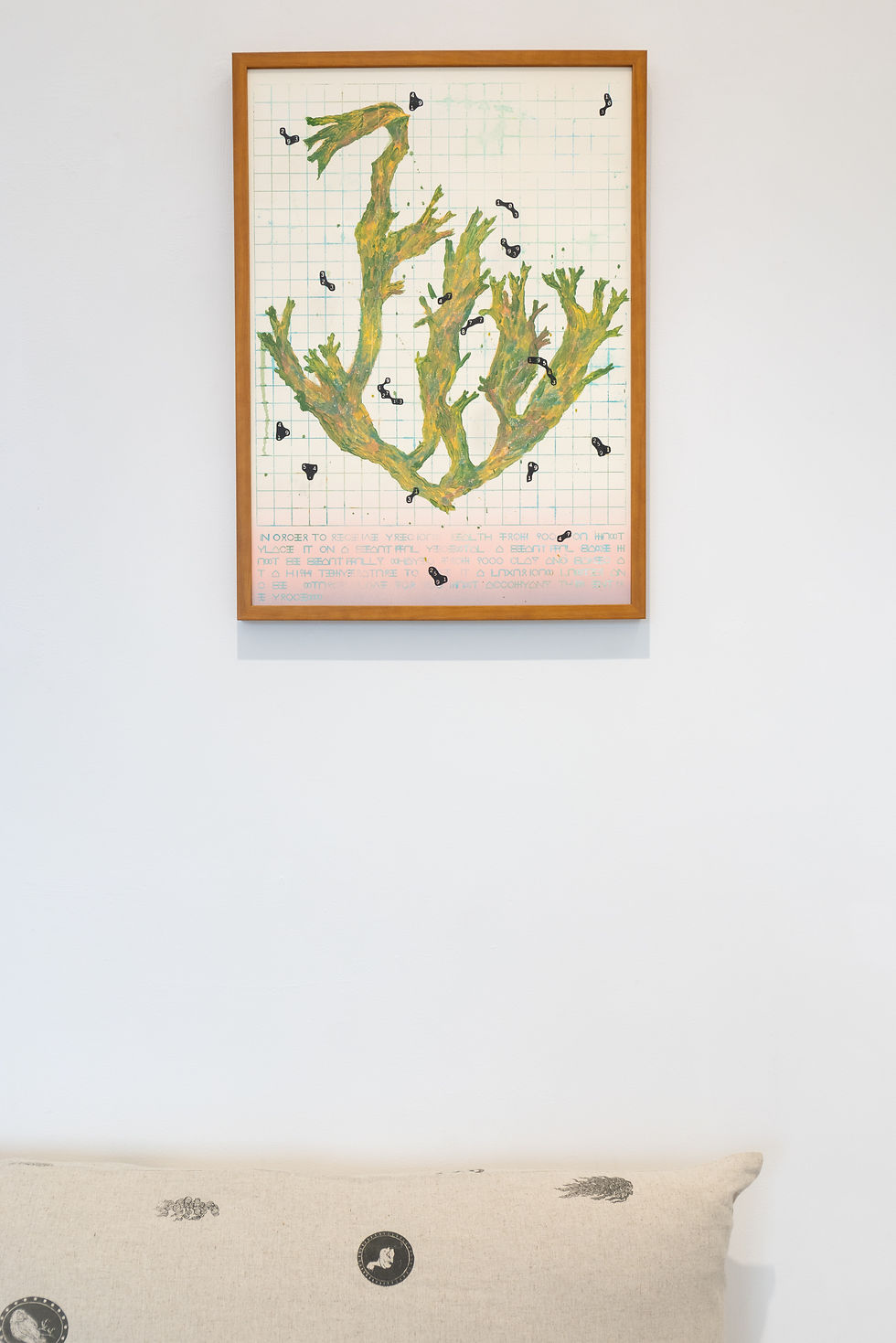
이번 작업에서 작가는 익숙한 금속 조각칼을 잠시 내려놓고, '스퀴즈 보틀(Squeeze Bottle)'이라는 낯설고도 부드러운 도구를 손에 쥔다. 주삿바늘 끝에서 맺히는 잉크의 동그란 시작점은 마치 우리가 처음 기도를 시작할 때 가슴 깊은 곳에서 먼저 응집되는 마음의 덩어리와 닮아 있다. 아직 문장이 되지 못한 감정, 형상을 갖지 못한 염원은 하나의 점처럼 응축되어 있다가 비로소 밖으로 밀려나오는듯하다. 손의 압력에 따라 굵어지거나 가늘어지는 선들은 매끄러운 종이 위를 지나 마침내 거친 흙의 표면 위로 옮겨간다. 선이 도자기의 몸체가 되고, 그 흙이 가마 속 뜨거운 불의 세례를 견뎌내며 단단한 상(象)이 되는 과정. 그 여정은 인간의 통제 가능한 손의 압력, 통제할 수 없는 불의 작용 , 곧 우주의 힘과 맞닿는 지점을 드러낸다. 오랫동안 종이의 평면성에 젖어 있던 그가 이제 흙을 통해 고백하는 것은 단순한 재료의 확장이 아니라, '뭍으로 올라온 존재’로서의 해방감이다. 작업 속에 등장하는 인간과 동물들은 종교적 위계 안에 놓여있지 않다. 그들은 모두 두려움이라는 근원적인 감정을 공유하는 연약한 생명체들이다. 생존의 공포를 넘어 무언가에 기대고 싶어 하는 그들의 몸짓은, 우리가 신성하다고 믿어온 종교 의식의 본질이 결국 취약함의 고백이었음을 나직이 말해준다. 흙 위에는 작가의 손이 남긴 지문이 새겨지고, 작품 속 존재들은 어떤 의식을 치르는 듯한 몸짓을 취한다. 그것은 신을 향한 경배라기보다, 두려움을 견디기 위한 자세 같기도 하며 불안을 건너기 위한 리듬에 가깝다. 신은 그렇게 만들어졌고, 의식은 그렇게 시작되었을 것이다.
판화가 인류의 정보를 새기고 전파해온 가장 오래된 연결의 장치라면, 흙은 그 새김의 과정 속에서 일어난 떨림과 망설임의 시간을 고스란히 기억한다. 입체와 평면, 기록과 기억이라는 두 세계는 비로소 한 몸 안에서 호흡한다. 원초적인 생명력 흙과 불이 남긴 우주의 신호를 따라 걷다 보면, 우리는 어느새 각자의 마음속에 지어두웠던 이름 없는 사원을 발견하게 된다. 오래전 흙 속에 심어 두었던 기도는, 불의 시간을 견디고 돌아와 이곳에서 우리를 조용히 기다리고 있다. 그리고 우리는 그 공간을 지나며 다시 한번 조용히 숨을 모은다.
박상아 작가의 개인전 《 아토포스 Atopos의 사원으로 돌아오는 기도 》 가 4월 3일부터 4월 24일까지 컴바인웍스 갤러리에서 개최된다




박 상 아 朴相娥 (b.1982- )
2006 홍익대학교 판화과 졸업
2008 홍익대학교 일반대학원 졸업
2013 숭실대학교 미디어학부 미디어아트전공 박사과정 수료
Solo Exhibition
2024 너의 당연한 바람과 나의 사원 Your Common Desires and My Temple -전시공간 / 서울
2016 The Non-Mathematical Greens 비수학적 식물 -토이리퍼블릭 / 서울
Group Exhibition
2025 더 드로잉 : 나에게 드로잉이란 - 소마미술관 / 서울
2025 춘천 예술촌 3기 입주작가 연속전시, 부유하는 짐작된 전언 - 박상아, 이웅철 2인전 - 춘천예술촌 갤러리
2025 바다에 비춰보면 - 노경민 , 박상아 2인전 - 1984 / 서울
2024 5점을 잇는 선 -아트팩토리 / 파주
2023 Magic Printer - 박상아, 장파, 최혜경 3인전 - 전시공간 / 서울
2022 워밍 업 -책은 선물 / 제주2022 - 제10회 울산국제목판화페스티벌 -울산 박물관 / 울산
2021 Primorye State Art Gallery, Vladivostok, Russia -블 라디보스토크 국립미 술 관 / 러시아
2019 스타워즈 아티스트 콜라보레이션 -전주국제영화제 / 전주
2018 グロテスキュン展 - Kai Gallery / 일본
2018 후기 애스펙트-’운명적 조우’ 전 Post Aspect-’The fateful encounter’ - 쉐마미술관 / 청주
2015 소마 드로잉_무심(無心)” -소마드로잉 센터 / 서울
2015 CODEX 북페어 -샌프란시스코 / 미국
2011 KWANHOON projects_Young Artists展 Contest 2011 -KWANHOON Gallery / 서울
2010 2011-‘내일-오픈 아카이브 展’ –
소마 드로잉 센터 / 서울 소마 드로잉 센터 아카이브 1기 선정작가
춘천문화재단 ‘춘천 예술촌’ 3기 ,4기 입주작가
다비 판화 작업실,전시공간 all-time space 운영/경희대학교 겸임교수
-


![표류하는 푸른 점 [ Drifting Blue Dot ]](https://static.wixstatic.com/media/b7e695_1c2ac677f51b47d38b47113d6182ce82~mv2.jpg/v1/fill/w_980,h_1386,al_c,q_85,usm_0.66_1.00_0.01,enc_avif,quality_auto/b7e695_1c2ac677f51b47d38b47113d6182ce82~mv2.jpg)
댓글